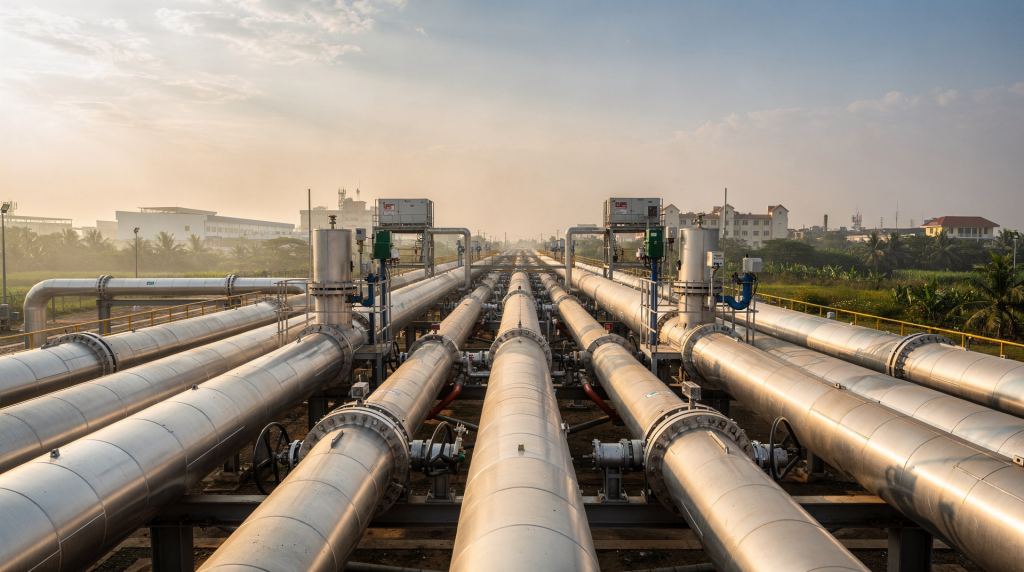
When I started managing pipeline integrity in oil and gas, the rule was brutally simple: the pipe must not leak. Over time, I learned that integrity isn’t just the absence of leaks. It’s the confidence that a system will perform its job without surprises for its entire service life. In residential projects, the same logic applies. A water main must deliver adequate pressure during the morning peak, a gas network must hold a steady 21 mbar at every cooktop, and a sewer line must drain without backing up. When one of those fails, it’s not an abstract engineering problem — it’s a family without water, a gas smell in the kitchen, or a flooded basement.
This article lays out the principles that keep industrial pipelines reliable, and I’ll show how each one translates directly to the utility networks that serve Indian housing developments. Whether you’re an operator, a builder, or a homebuyer trying to ask the right questions, the fundamentals are the same.
What pipeline integrity management actually means
Pipeline integrity management is not a one-time inspection. It’s a structured, living program that ties together design review, risk assessment, monitoring, maintenance, repair, and continuous improvement. For a residential gas network, that means you don’t just check for leaks once after construction. You maintain a documented cycle that keeps the system safe decade after decade.
A solid program answers five questions:
- What is the pipeline supposed to do?
- What can go wrong?
- Where is the risk highest?
- How will the operator detect change?
- What action will be taken before failure occurs?
In Indian operations, this often includes scheduled monitoring, integrity assessments, and documented mitigation plans. For a housing society, the “operator” might be the facility management team or the municipal water board, but the discipline is identical: know your network, watch it, and act early.
The core principles of reliable pipeline operations
1) Build integrity into the design, not after the problem appears
The best integrity program starts before the first cubic metre of water flows. Baseline data — construction records, material certificates, weld maps, coating details, pressure test results — becomes the reference for every future decision. If that baseline is weak, later inspections lose their value. You might detect a thin spot on a pipe, but you won’t know if it’s new corrosion or a manufacturing defect that was always there.
In a residential water supply scheme, this means recording the exact pipe material (uPVC, HDPE, or steel), the pressure class, jointing method, and the results of hydrostatic testing. When, five years later, pressure drops on the top floor, you can compare current performance with the as-built data and quickly isolate whether the problem is a clogged pipe, a pump issue, or an illegal tap.
Practical takeaway:
- Keep complete as-built drawings.
- Record material grades, weld maps, coating data, and test results.
- Document crossings, bends, valves, and other high-risk locations.
- Treat commissioning records as part of the integrity file, not as paperwork.
2) Identify threats early and rank them by risk
A pipeline doesn’t fail randomly. Most incidents trace back to identifiable threats: corrosion, third-party damage, soil movement, material defects, operator error, or poor maintenance. Risk ranking helps you focus on the segments that matter most. A gas pipe crossing under a busy road deserves far more attention than a straight run through an open garden.
For residential networks, the threat profile shifts depending on the utility:
- Natural gas (low pressure, typically 21 mbar at the appliance): mechanical damage from nearby excavation, corrosion of unprotected steel risers, and poor-quality threaded joints inside apartments.
- Water supply: internal corrosion of ageing steel mains, pressure surges from pump starts, settlement under heavy buildings, and contamination through leaky joints during low-pressure periods.
- Sewerage: blockages from debris and wipes, root intrusion at joints, pipe displacement due to ground settlement, and grease accumulation in kitchen waste lines.
Common threat categories:
- Internal corrosion from water, contaminants, or process conditions
- External corrosion from coating failure or cathodic protection issues
- Mechanical damage from excavation or impact
- Geotechnical movement from settlement or landslip
- Fatigue or stress at bends, welds, and crossings
- Valve or instrument malfunction
- Human error during operation or maintenance
3) Use monitoring that matches the threat
Monitoring works only when it’s tied to the actual failure mode. Corrosion demands wall-thickness and potential measurements; leakage risk demands pressure, flow, and alarm visibility. In large Indian townships, SCADA systems are increasingly used to track water pumping stations — pressure at the discharge header, flow into the distribution network, and reservoir levels. A sudden pressure drop at 2 a.m., when no pumps are running, can point to a hidden leak long before residents complain.
For gas networks, even a simple pressure transmitter on the incoming main can make a difference. If the pressure downstream of the regulator drifts below 18 mbar during peak cooking hours, the operator knows there’s either a supply constraint or an abnormal load — possibly a leak. Smart monitoring doesn’t require a sensor on every metre; it requires the right measurement at the right point.
Typical monitoring tools include:
- SCADA for continuous pressure, flow, pump status, and valve position
- Inline inspection tools (smart pigs) for detecting internal defects
- Pressure and flow trending
- Corrosion monitoring (coupons, probes, or ultrasonic spot checks)
- Valve status verification
- Leak detection systems (acoustic or pressure-wave based)
- Soil-to-pipe potential checks where corrosion risk is high
- Targeted inspections at crossings and vulnerable locations
The principle is straightforward: the more critical the segment, the more precise the monitoring should be.
4) Inspect periodically, not only after alarms
A reliable line needs planned integrity assessments, not just reactive response. Some defects grow slowly and remain invisible on daily SCADA screens. External corrosion under disbonded coating, for instance, won’t show up as a pressure drop until the wall is nearly perforated. Periodic inspections catch that growth early.
In residential sewer networks, a CCTV inspection every two years is not a luxury — it’s the cheapest way to avoid a messy overflow. The camera reveals cracks, root intrusion, and sags that can trap solids. For water mains, ultrasonic thickness gauging on older steel sections gives a direct reading of remaining wall thickness and lets you plan replacement before a burst floods the street.
Common assessment methods:
- Inline inspection (smart pigs) for long-distance transmission lines
- Pressure testing for newly installed or repaired segments
- Direct assessment for external corrosion on buried pipes
- Ultrasonic thickness measurement
- Coating surveys and cathodic protection audits
- Corrosion probing at suspect locations
Why this matters:
- Some defects grow slowly and stay invisible on daily monitoring.
- Some threats develop outside the pipe and are not seen from the control room.
- Early detection reduces repair cost and outage duration.
5) Treat maintenance as risk reduction, not routine housekeeping
Maintenance in an integrity program is targeted. It’s not about ticking a checklist; it’s about reducing the probability of failure at the most vulnerable points. In a housing complex, that means quarterly functional tests of fire hydrants and isolation valves, annual exercising of gas shut-off valves on each riser, and pre-monsoon cleaning of stormwater drains — not because the manual says so, but because a stuck valve during a fire or a clogged drain during a heavy downpour is a direct threat to life and property.
Useful integrity-focused maintenance actions include:
- Valve testing and functional checks
- Cleaning and pigging at planned intervals
- Coating repair
- Cathodic protection verification
- Thickness measurement on above-ground piping
- Leak surveys at critical points
- Inspection of crossings, supports, and exposed sections
A good operator doesn’t ask, “Was maintenance done?” The better question is, “Did maintenance reduce the identified risk?”
A practical integrity management workflow
| Step | What happens | Why it matters |
|---|---|---|
| 1. Asset knowledge | Collect design, construction, and operational data | Creates the baseline for decisions |
| 2. Threat identification | List internal and external threats | Prevents blind spots |
| 3. Risk ranking | Prioritize the highest-consequence segments | Focuses resources where they matter most |
| 4. Integrity assessment | Use ILI, pressure tests, surveys, and inspections | Finds defects before failure |
| 5. Mitigation | Repair, replace, isolate, or protect vulnerable sections | Reduces incident probability |
| 6. Monitoring | Track pressure, flow, corrosion, and alarms | Detects change early |
| 7. Review | Measure performance and improve the program | Keeps the system effective over time |
Applied to a township water supply, the workflow looks like this: you map the network and record materials (Step 1), identify that corrosion of old steel sections and illegal connections are the main threats (Step 2), rank segments by the number of homes they serve (Step 3), run ultrasonic scans and leak detection surveys (Step 4), replace a corroded 100 metre stretch (Step 5), install pressure loggers at critical nodes (Step 6), and review breakage statistics annually to adjust the replacement programme (Step 7).
Smart monitoring: what it should actually do
Smart monitoring is not about installing sensors everywhere. It’s about placing the right measurement at the right point. In a residential gas network, a single pressure transmitter on the downstream side of the main regulator, combined with flow totalisers at each block, can give a clear picture of network health. If the pressure holds steady at 21 mbar during zero-flow periods but dips when demand rises, the pipe sizing or regulator capacity may be inadequate. If pressure decays slowly with no consumption, you likely have a leak.
A useful monitoring setup should:
- Detect abnormal pressure or flow changes quickly
- Confirm valve positions and isolation capability
- Identify wall loss or corrosion growth
- Support targeted intervention rather than blanket maintenance
- Produce data that engineers can interpret, not just data that looks sophisticated
In practice, the best systems combine real-time monitoring with risk-based analytics so operators can focus on the weakest sections first.
Common integrity failures and what usually causes them
| Failure mode | Typical cause | What to watch for |
|---|---|---|
| Corrosion | Coating damage, water ingress, poor protection | Wall thinning, potential drift, recurring repairs — especially on old steel water mains without cathodic protection |
| Leak | Defect growth, joint failure, impact | Pressure drop, odour, unexplained loss — in gas systems, often at threaded connections behind the stove |
| Rupture | Severe damage or delayed intervention | Escalating alarms, abnormal flow changes |
| Blockage | Deposits, debris, scaling | Reduced capacity, pressure instability — common in sewer lines after construction debris is flushed |
| Valve failure | Wear, poor testing, lack of exercise | Poor isolation, slow or incomplete shutoff |
| Settlement damage | Soil movement, unstable ground | Misalignment, stress, recurring coating cracks — often seen where pipes cross filled ground or approach heavy structures |
The role of standards and documentation
Reliable operation depends on disciplined documentation. In India, gas distribution networks follow the technical regulations of the Petroleum and Natural Gas Regulatory Board (PNGRB), while water supply and sewerage systems refer to the CPHEEO manual and local municipal codes. The exact standard varies by utility, but the principle is universal: define the method, document the risk, record the inspection, and prove the response.
For a homebuyer, this has a practical implication. Before taking possession, ask the builder for the gas pipeline pressure test certificate, the water supply network’s disinfection and pressure test reports, and the sewer line’s gradient and leak test records. If those documents don’t exist, you’re buying a promise, not a proven system.
Minimum documentation should include:
- Integrity management plan
- Threat and risk register
- Inspection and test reports
- Repair records
- Alarm and incident logs
- Calibration and maintenance history
- Change-management records
- Review and improvement actions
If it is not documented, it is hard to prove the pipeline is being managed correctly.
Step-by-step checklist for operators
Before startup
- Verify the as-built file is complete
- Confirm material traceability and weld records
- Check pressure testing and commissioning data — for gas, ensure pneumatic tests were done at the correct pressure and duration
- Confirm cathodic protection and coating records
- Identify high-risk crossings and vulnerable sections
- For residential gas: verify that every threaded joint is sealed with approved tape or anaerobic compound
During operation
- Monitor pressure, flow, and valve status continuously
- Review alarms daily
- Trend corrosion and defect indicators
- Inspect critical sections on schedule
- Compare current readings with baseline values
- Walk the gas network weekly with a portable gas detector at valve pits and exposed risers
- Check water pressure at the highest and farthest flats during peak demand
After a defect is found
- Classify the severity
- Estimate growth rate
- Decide whether to repair, isolate, reduce load, or replace
- Document the decision and timeline
- Verify the corrective action actually reduced the risk
- For a gas leak inside a flat, shut off the riser immediately, ventilate, repair, and re-test before restoring supply
Typical mistakes that weaken pipeline integrity
- Treating inspection as a one-time event
- Using monitoring data without risk ranking
- Ignoring the as-built baseline
- Delaying repairs on “small” defects — a minor gas weep can become a major hazard
- Focusing only on the pipe body and forgetting valves, crossings, and supports
- Running a high-tech monitoring system without trained personnel
- Failing to close the loop after a repair
- In residential schemes, neglecting stormwater drains until the monsoon arrives
These mistakes are avoidable. Most integrity failures are not caused by a lack of technology; they are caused by weak process discipline.
Why this matters for Indian infrastructure projects
India’s pipeline networks operate in dense urban conditions, mixed soil environments, and high-growth corridors. A gas line laid today may find itself surrounded by new construction within two years. Water mains compete for space with telecom ducts, storm drains, and electricity cables. Every excavation by a neighbouring plot becomes a potential threat.
For residential developments, the stakes are personal. A family that cannot get water pressure for a morning shower, or that smells gas in the stairwell, quickly loses trust in the builder and the utility. Beyond inconvenience, failures affect safety, continuity of supply, maintenance costs, environmental compliance, and regulatory standing. A township with a well-documented integrity programme — where the water pressure is guaranteed, the gas network is tested annually, and the sewers are camera-surveyed — is not just an engineering achievement; it’s a liveable, valuable asset.
That is why utility infrastructure planning and industrial integrity management share the same foundation: know the asset, monitor it properly, and act before failure spreads. When you evaluate a property, ask how the builder manages these invisible lifelines. The answer tells you more than any brochure.
Final takeaway
A reliable pipeline operation is built on four habits: understand the asset, rank the risk, monitor the right variables, and respond early. When those habits are embedded into daily operations, integrity becomes a managed system rather than a reactive scramble.
FAQ
What is the main goal of pipeline integrity management?
To keep the pipeline safe, leak-free, and fit for service by identifying threats early and reducing the chance of failure. For a gas network in your home, that means no smell of gas and a steady 21 mbar at the stove. For water, it means clean supply at adequate pressure whenever you open a tap.
What is the difference between inspection and integrity management?
Inspection finds defects. Integrity management uses inspection results, risk analysis, monitoring, and maintenance to prevent those defects from becoming incidents. A CCTV survey of a sewer may show a crack, but only a management programme decides whether to repair it now or watch it for another year.
How does SCADA help pipeline reliability?
SCADA provides continuous visibility into pressure, flow, pumping units, and valve status, allowing operators to detect abnormal conditions and respond quickly. In a township water supply, it can reveal a hidden leak when night-time pressure drops unexpectedly, or confirm that all pumps are running during peak demand.
What is an intelligent pig?
It is an in-line inspection tool that travels through the pipeline and detects anomalies, defects, or loss of metal that could affect integrity. While less common in small-diameter residential lines, intelligent pigs are valuable for large-diameter water transmission mains that feed entire neighbourhoods.
Why is baseline documentation important?
It gives operators the original reference condition of the pipeline, which is essential for comparing later measurements and judging whether degradation is occurring. Without it, you cannot tell if a pressure drop is a new problem or a pre-existing condition.
What is the biggest mistake in integrity management?
Ignoring weak signals until they become failures. The strongest programs act on early warnings — a faint gas odour, a patch of rust-coloured water, a slow drain — rather than waiting for a full-blown emergency.